Yesterday afternoon I stood on a street in Arlington and waited for monks to walk by.
They are Buddhist monks on a 2,300-mile Walk for Peace, traveling on foot, step by step, from Texas to DC to share a simple message of mindfulness and peace.
I had heard they move quickly, but I wasn’t prepared for just how quickly. One moment the street was full of people scanning the distance, craning their necks, chatting quietly in the cold. The next moment, a small river of saffron robes flowed past, silent, steady, focused, and then they were gone. The whole thing lasted maybe fifteen seconds.
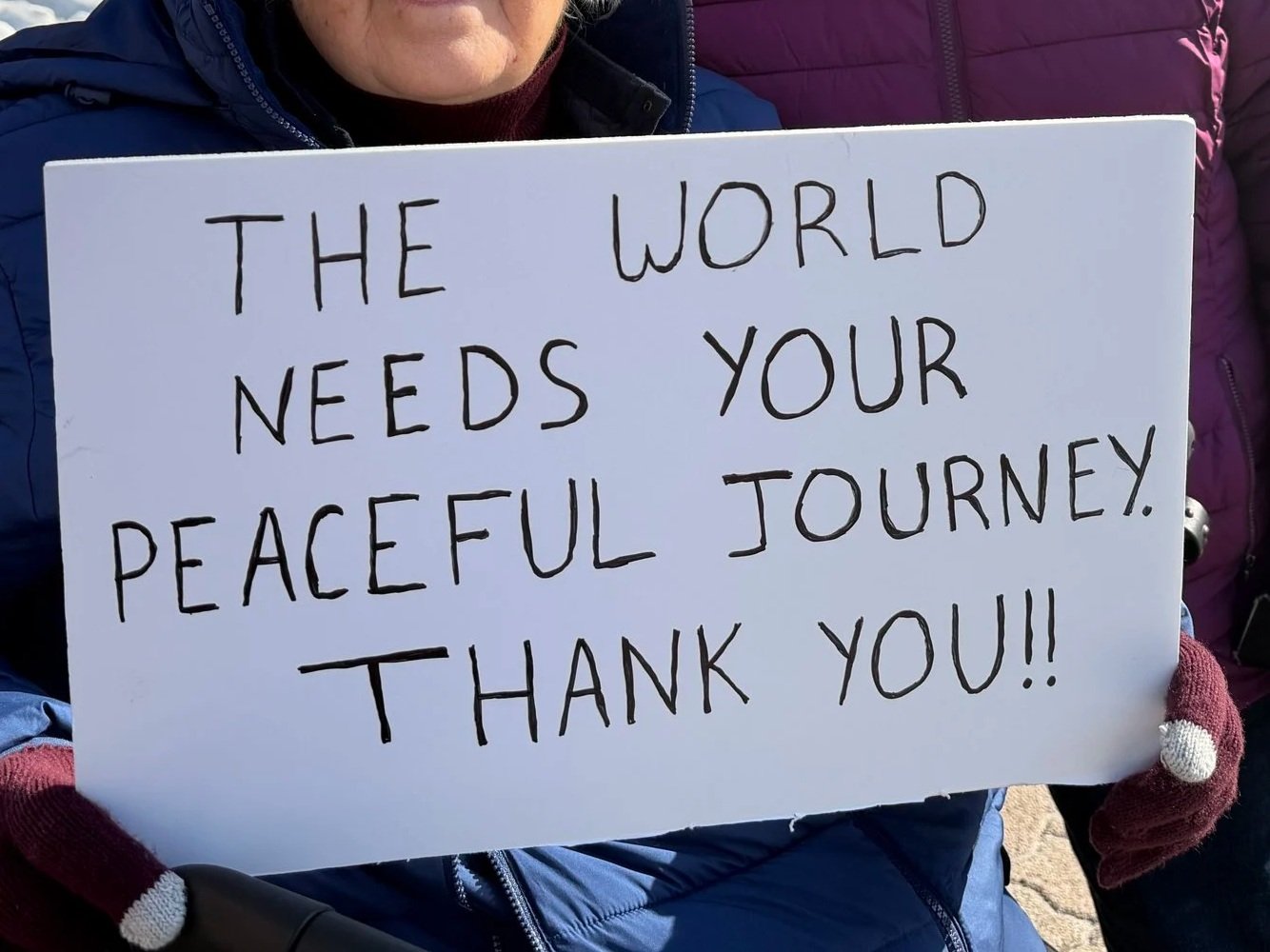
It was joyful being there. People gathered without fanfare or spectacle. Children waved. Strangers smiled at one another. Conversations sprang up between people who had never met. Even the police escorts on motorcycles, lights flashing, engines idling, were grinning as the monks passed. For a few minutes, an ordinary urban street felt softer and more human.
I had read that one of the monks had suggested people put their “lovers” (their phones) away so we could be present for the moment. And so I did. No photos. No video. Just watching.
It was a privilege to witness it.
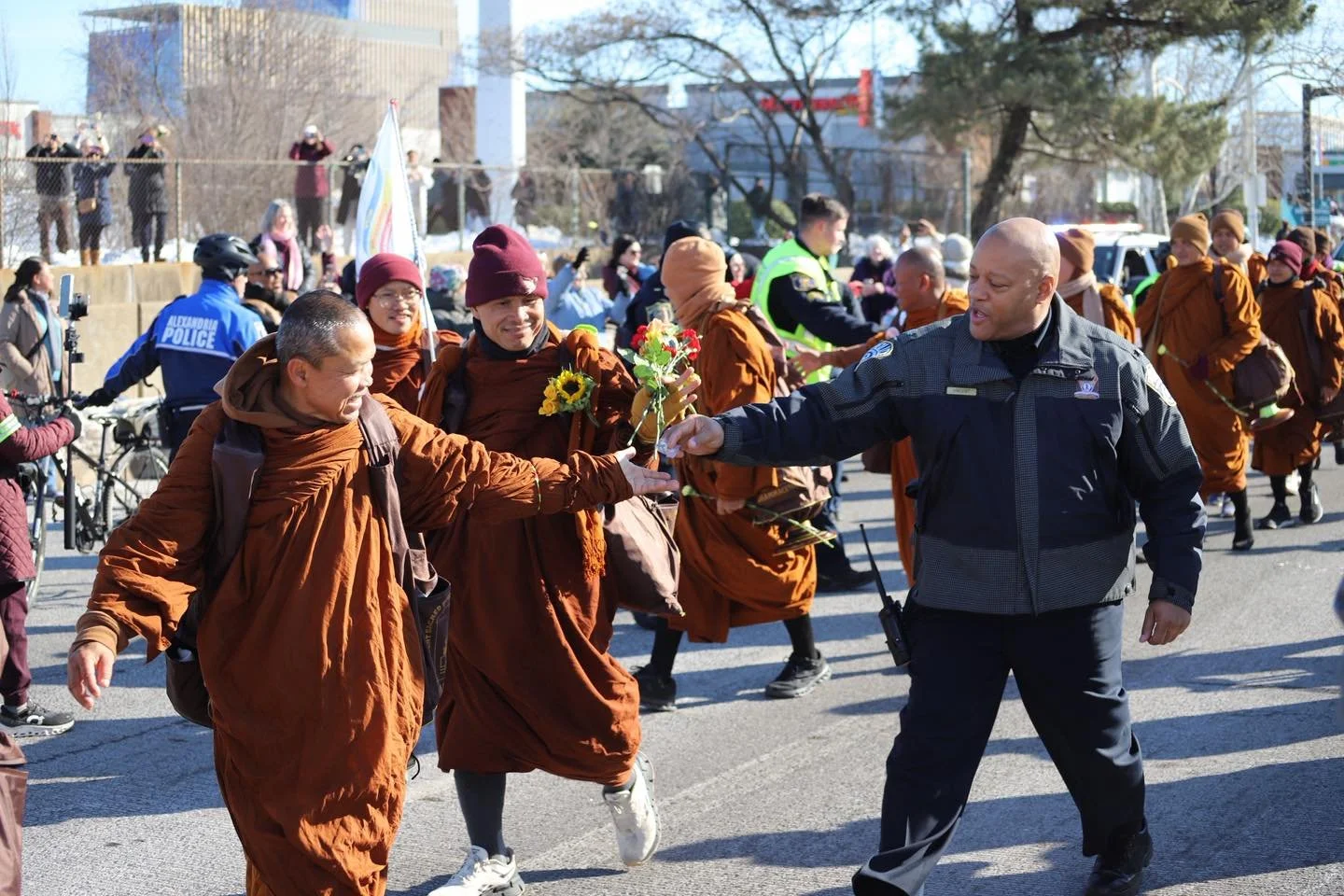
Photo: Arlington County Police Department
Earlier that morning, I had seen grumbling online about the walking monks. The rolling road closures, the inconvenience, the question of “what this could possibly accomplish.” We live in a world trained to value speed, productivity, and outcomes we can measure. If something cannot be graphed, counted, or turned into a headline, we grow suspicious of it.
What law will this pass? What policy will change? What problem will be solved by walking quietly across the country?
On the surface, the answer seems to be: none.
But watching them walk was witnessing something that exists outside the usual accounting systems of success. No preaching or recruiting, no insistence that anyone believe anything at all. Just quiet presence. Step after step. Mile after mile all the way from Texas. Through cold and rain and snow and ice. A moving invitation rather than an argument.
And people are responding. Children wave. Adults pause. Conversations begin. People who have never given mindfulness a second thought find themselves asking what it is. Something soft moves through the crowd. Something unhurried.
We often assume change only happens through force, urgency, and pressure. But history and our own lives tell a quieter story. Some of the most profound shifts begin invisibly. They begin in attention, perception, in the subtle moment when someone pauses long enough to notice their own reactivity and chooses a different response.
That is the kind of moment that shaped Mahatma Gandhi, who chose nonviolence in the face of empire.
It shaped Rosa Parks, who refused to stand up.
It shaped Martin Luther King Jr., who insisted on love in the face of hatred.
It shaped Nelson Mandela, who walked out of prison without choosing revenge.
It shaped Thich Nhat Hanh, who taught that peace is practiced in each step.
None of those moments looked dramatic at first or could be graphed on the day they began. Each started with a shift, followed by a different kind of action.
Mindfulness does not force action but makes wise action a lot more possible. It loosens the grip of reactivity so clarity has somewhere to land. And in a time that feels combustible, the simple act of walking quietly for peace feels almost radical.
Venerable Bhikkhu Pannakara, leader of the Walk for Peace, has been sharing a simple sentence along the way: “Today is going to be my peaceful day.” It sounds simple. But maybe that is the point. A single intention carried step by step across miles, across states, across encounters with strangers.
I read that one of the monks gently asked a crowd: What will you do with this? Will you simply watch us pass by, or will you learn something from it?
That question lingers. Because perhaps the point is not what the walk accomplishes for us, but what it invites from us. For me, as someone whose life has been made better by meditation and mindfulness, seeing them walk was deeply moving. It reminds me that not all change arrives through urgency or argument. Some change arrives quietly, one step at a time, asking nothing more than our attention.
And if even a handful of people pause, breathe, soften, and carry that forward into their homes, their work, their conversations, their decisions?
That is not nothing.